
'The real story of 2025 is that India officially stopped being a 'market of the future' and started acting as the world's primary economic engine.'

The ICC says it is monitoring the air quality in smog-shrouded New Delhi ahead of the World Cup match between Bangladesh and Sri Lanka on Monday.

Buildings were decorated with colourful lights and earthen lamps dotted houses as people across the country thronged temples and celebrated Diwali with pomp on Monday.

The Indian government has announced staggered working hours for its employees in Delhi due to the severe air pollution in the city. The move comes after a week of 'severe' pollution levels, which have slightly improved but are still in the 'very poor' zone. The order also encourages employees to pool vehicles and use public transport to minimize vehicular pollution.
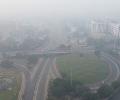
An AQI of 400 or higher is deemed 'severe' and it can have an adverse effect on both healthy individuals and people who already have medical conditions.

The Delhi government has ordered half of its staff to work from home, urging private organizations to follow suit as the national capital faces an alarmingly high level of air pollution. The move comes as Delhi recorded an Air Quality Index (AQI) of 426 in the "severe" category, with residents reporting health issues. Essential services will continue to operate at full capacity. The government has also advised companies to provide shuttle bus services for employees and suggested that private entities consider shifting office hours to reduce traffic congestion.

Heavy rains lashed Delhi, leading to a red alert, traffic snarls, and waterlogging. The IMD predicts continued rainfall.

Squandering the relief due to rain, Delhi recorded a jump in pollution levels and a smoky haze returned on Monday after people flouted the ban on firecrackers on Diwali night.
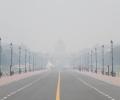
The city's average air quality index (AQI) stood at 220 at 12 noon, improving from 263 at 4 pm on Monday.

BCCI banned the display of fireworks during the World Cup games in Delhi and Mumbai due to worsening air quality.

The Taj Mahal in Agra was engulfed in a layer of haze on Monday morning amid the rise in air pollution levels, with tourists unable to believe their eyes.

As many as 12 flights were diverted at the Delhi airport between 3 pm and 4 pm due to adverse weather conditions, an official said.

Health expert termed the problems caused due to the rise in pollution as a "medical emergency".

The air quality is expected to improve further due to wind speed favourable for the dispersion of pollutants.
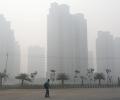
Air pollution may lead to a faster spread of Covid-19 infection as it causes coughing and sneezing, government officials told a parliamentary panel on Friday, according to sources.

Delhi's air quality deteriorated significantly on Monday, with areas like Dwarka, Mundka and Najafgarh recording an AQI of 500, the worst this season. The city's overall AQI reached 491, triggering the implementation of the Graded Response Action Plan (GRAP) Stage-IV restrictions in Delhi-NCR. Doctors warned of health risks, urging people to wear N95 masks and avoid outdoor activities. The Supreme Court questioned the Delhi government on its anti-pollution measures and warned against scaling down preventive measures without its permission. Delhi Chief Minister Atishi accused the BJP-led central government of political maneuvering while neglecting stubble burning in states it governs. Meanwhile, the city enforced stricter pollution control measures, including a ban on truck entry and suspension of construction activities. Air purifier sales surged, reflecting the public's concern over the severe air pollution.

India captain Rohit Sharma expressed deep concerns about the vitiated air quality in Indian cities.

Squandering the relief due to rain, Delhi recorded a jump in pollution levels and a smoky haze returned on Monday morning after residents flouted the ban on firecrackers on Diwali night.

Dense fog enveloped Delhi for a second consecutive morning, leading to disruptions in air and rail traffic. Visibility dropped to zero in several areas, causing delays for 81 trains and diversions for 15 flights. The Met office attributed the fog to calm surface winds, and predicted continued dense to very dense fog throughout the day. Meanwhile, the national capital's air quality remained in the 'very poor' category, with an AQI reading of 380 at 9 am.

As the air pollution in Delhi-NCR ameliorated over the last two days, the Centre's air quality panel Sunday directed authorities to lift the ban on plying of non-BS VI diesel light motor vehicles in the region and the entry of trucks into the capital imposed under the final stage of the Graded Response Action Plan.

'Whether it was air quality or what, it was definitely an experience I've not had before.'

Thirteen cities of the country had an average Air Quality Index above 400, which falls in "severe" category, with seven of them in Uttar Pradesh, five in Haryana and one in Bihar, according to the Central Pollution Control Board.

The minimum temperature in the capital dropped to 9.6 degrees Celsius, three notches below normal and the lowest this season so far. The maximum is likely to settle around 27 degrees Celsius, the India Meteorological Department said.

Delhi BJP vice president Kapil Mishra hailed people for defying the cracker ban.

It was a competition and each camel performed to the best of their ability, delighting the crowd.

Gaps in enforcement, limited monitoring, and easy access to firecrackers from the NCR region where restrictions were slack were largely responsible for the widespread flouting of the cracker ban in Delhi on Diwali, experts have opined.

'Many of these patients arrive at emergency departments in distress, struggling to breathe and requiring immediate medical intervention.'
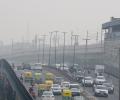
'The pollution has increased. We are facing breathing problems and irritation in the eyes'

The Bombay High Court has declared a pollution-free environment a constitutional right and criticized the Maharashtra government for failing to address the issue of air pollution in Mumbai. The court expressed its disappointment with the government's lack of initiative, stating that citizens should not suffer due to the inaction of authorities. The court highlighted the severe air pollution levels in Mumbai, especially along major roads, and ordered the traffic department to take immediate action to reduce congestion and improve traffic flow.
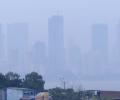
'If we don't control the additional pollutants that come from various human activities then, the pollution level will not come down.'

A thick layer of fog was seen in several parts of the city, weather officials said.

The Supreme Court on Friday agreed to list for hearing on November 10 a PIL seeking issuance of fresh guidelines on stubble burning to curb rising air pollution in Delhi and the national capital region (NCR).
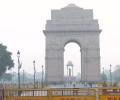
According to forecasting agencies, the city is set to record its best air quality for the day after Diwali since 2015 on Tuesday.

The increase in stubble burning has kicked off a political slugfest, with Union Environment Minister Bhupender Yadav on Wednesday saying that there had been a 19 per cent rise in farm fires over 2021 in Punjab and that the Aam Aadmi Party had turned the national capital into a gas chamber.

Pollution levels in the national capital entered the "severe" zone for the first time this season on Thursday, with scientists warning of a further spike over the next two weeks.

According to Ministry of Earth Science's air quality monitor 'SAFAR', the air quality is likely to improve from Friday onwards due to better wind speed.
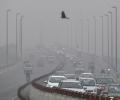
With Delhi recording air pollution levels seven to eight times above safe standards on Monday, the city government announced the return of its flagship odd-even scheme after four years anticipating further deterioration of air quality post-Diwali.

In India, the pollution levels are highest in the north.

The nationwide 'Janta Curfew' followed by the 21-day lockdown to combat the coronavirus outbreak have led to a significant reduction in pollution in the country, with 91 cities recording air quality in the 'good' and 'satisfactory' category on March 29, a Central Pollution Control Board report has stated. Travel restrictions and the closure of industries have helped reduce the pollution level, it said.
The sustainable impact of this process is under scrutiny, Tripathi added.
